
RISE Model
RISE was built to be more holistic, person-led, and flexible than other interventions, by integrating proven and promising methods from other fields and adapting them to the unique context of elder abuse.
RISE is grounded in a simple belief: Older adults have better outcomes when they are treated not as problems to be fixed, but as people with the desire and capacity to direct their own lives. That means taking time to build trust and discover what matters most to them (which might be getting help for someone else). We ask: What does “help” look like for you?
Grounded in Theory
“RISE” stands for:
1.
The methods integrated into the model
2.
The levels at which it operates.
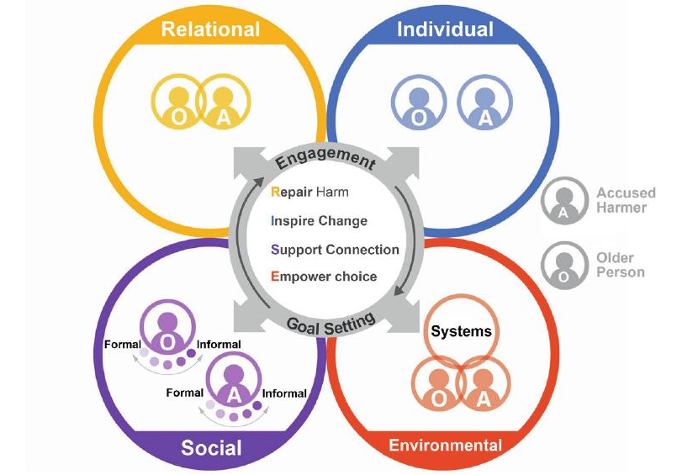
Four Methods, Four Levels
RISE integrates four core methods — delivered by trained advocates — across four levels of a person’s life. Working at all four levels, rather than just the individual level, is what allows RISE to address the full context in which abuse, neglect and exploitation occur.



Repair Harm
Restorative justice approaches aim to reduce harm, promote healing, and help those involved in conflict work toward meaningful accountability and transformational change

Inspire Change
Motivational interviewing helps people feel that change is possible

Support Connection
Teaming is used to build more consistent formal (like Meals on Wheels) and informal (like neighbors) supportive networks around people in need

Empower Choice
Supported and interdependent decision-making assists people with cognitive impairment to achieve their goals
How RISE is Different
Theory and Core Modalities
RISE is grounded in ecological, relational, and client-centered theory and integrates core modalities (motivational interviewing, restorative justice, teaming, supported decision making) in which the advocates are trained.
Holistic Approach
RISE works with cases at Relational, Individual, Social, and Environmental levels of influence. Specifically, we work with both older adult victims and others, including alleged harmers, their relationships, family members, and strengthen the social support systems surrounding them.
Prevention and Response
We work with older adults aged 60 years or older who are either experiencing elder mistreatment or at risk of elder mistreatment with potential for escalation without proper supports in place. This way, we engage in both prevention and response work.
Build Trusting Relationships
Advocates can stay involved in cases longer than most formal system responders are usually able to, allowing advocates more time to build trusting relationships with and social support around older people, families, and concerned others.
Client-Centered Approach
Advocates work in a truly client-centered way. We understand that each case is different based on the type of abuse, neglect or self-neglect, the way each older adult perceives their situation, and the relational dynamics surrounding the problem. We collaborate with clients to develop person-centered goals.